
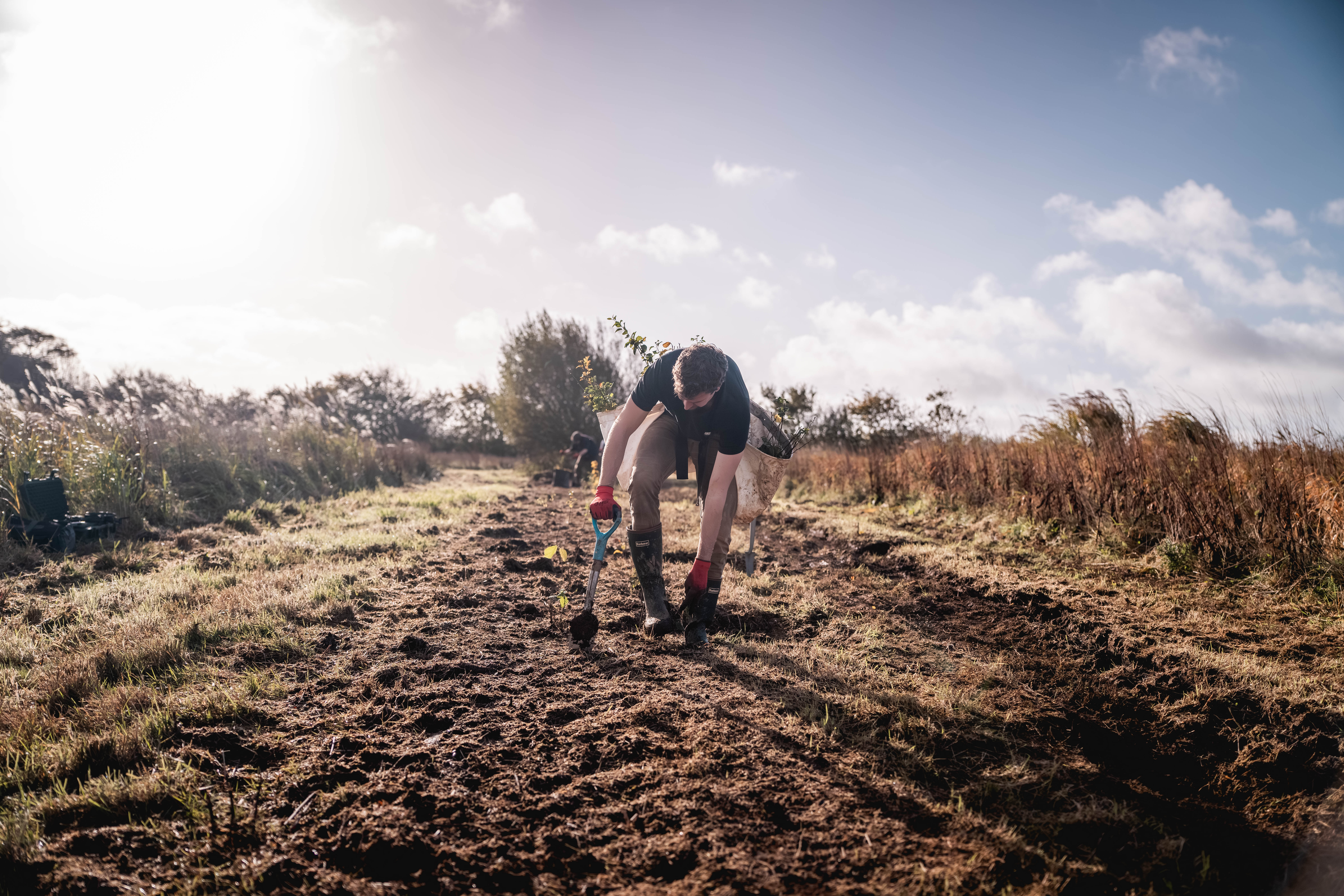
In a world increasingly feeling the realities of climate and biodiversity collapse, Oxygen Conservation is both a business and a blueprint for using capital to drive positive impact and risk-adjusted returns.
We believe risk is a reality of what we do and something to be understood, embraced, and ultimately used as a guide to strategic decision-making. While many organisations react, freeze, or act defensively in the face of risk, we position it at the centre of our strategy, recognising it, measuring it, mitigating it, and harnessing it.
Our approach to risk management can be traced to years spent in high-risk environments, including, in my case, navigating whitewater rapids or paddling off waterfalls. It’s shaped by the mindset of performance athletes, where preparation, decision-making under pressure and measured instinct are non-negotiable. At the same time, it’s grounded in data, in numbers, in game theory – where understanding probability, decision trees, and human psychology gives you the edge.
Some say the world’s best risk managers are extreme athletes or elite poker players, those with absolute clarity of purpose and acute awareness of consequence. And we use that fusion of instinct and intellect to turn risk into opportunity, not obstacle.
This philosophy doesn’t sit on a shelf—it’s embedded in how we acquire land, engage communities, and scale nature-based solutions. Our unique background allows us to blend boldness with caution, imagination with evidence. From restoring temperate rainforest on Dartmoor to rewilding sheep-depleted uplands in Scotland, every decision we’ve made has tested the boundaries of what’s possible in both conservation and capital. And yet, we’ve flourished – scaling to over 50,000 acres across the UK and connecting more than half a million acres for nature. Every estate, every intervention, every stakeholder conversation has strengthened our framework.
So, how do we do it?
1. A Culture of Radical Transparency
We’ve institutionalised openness. Our teams are empowered with the full context, not partial information. From our shoot room-turned-podcast studio to our estate teams equipped with real-time data, we enable every individual to understand, communicate, and access risk. Mistakes are met not with blame, but with kindness and curiosity. Lessons aren’t hidden – they’re discussed, debated, written down, and embedded in our DNA. This transparency fosters trust, accelerates learning, and helps ensure we rarely make the same mistake twice.
2. Operational and Strategic Dual-Lens Risk Framework
Operational risk? That’s the daily work – off-road vehicles, excavators, and drones. Managed locally, in the field and by those who know the land best. These risks are contextual and highly specific, often physical and immediate.
Strategic risk? That’s the future – how we make decisions that protect and propel our long-term goals.
Strategic risks are often harder to quantify, but their impact is often far greater. Managing them well requires absolute clarity of purpose, ongoing analysis and a tolerance for ambiguity.
3. Risk Scoring Meets Pragmatism
We use scoring systems, yes. But we also understand their limitations. Numbers don’t tell the whole story. They are one lens, powerful but partial. At Oxygen Conservation, we supplement quantitative analysis with diverse data sources, expert judgment, local knowledge, and the lived experiences of those with perspectives different from our own. This pluralism ensures that we capture nuance, uncover blind spots, and make decisions that are not only statistically sound but socially and ecologically informed. So, we combine formal risk matrices with a structured “hierarchy of control,” designating ownership, ensuring regular reviews, and supporting those closest to the risk to manage it best. Importantly, we ensure the scoring process is participatory, drawing on diverse perspectives to avoid blind spots and build consensus.
4. Governance as a Competitive Advantage
We have developed a ‘risk appetite’ framework with our exceptional board, which is designed to ensure rapid and precise interaction where risks are escalated for discussion and counsel. Governance, in this context, becomes a tool for acceleration – not constraint. By clearly delineating thresholds for action, escalation pathways, we transform governance into a high-performance mechanism. The result? We play faster, more confidently, and with greater clarity – unlocking speed through structure.
5. We Use Risk as a Growth Strategy
Where others see risk as a red light, we see it as a prompt to explore further, to ask sharper questions, and to dive deeper into the data. Every estate we acquire is both a calculated risk and a positive investment, backed by rigorous due diligence, strategic intent, and a broad understanding of ecosystem dynamics. An illustration of this was our acquisition of the Invergeldie Estate in Perthshire, which was completed within 4 weeks of our first viewing and added more than 11,000 acres to the portfolio in record time.
This wasn’t just luck; it was the product of disciplined risk management, a powerful demonstration of how our framework builds confidence, acceleration and impact. One of my key learnings from the wonderful book, Thinking in Bets by Annie Dukes, another world-class poker player, is that all decisions are part skill and part luck, and we will never know the exact balance of the two. Annie also teaches the importance of not assuming good decisions lead to good outcomes; they merely increase the likelihood of that positive outcome occurring – every decision is then a bet on a different version of the future.
6. An Integrated, Always-On System
We’re integrating risk management with data from across our portfolio – combining people, ecological, finance, and operations data into a single system. This is not about compliance. It’s about performance. About spotting trends earlier. Acting faster. Moving from reactive to predictive. We’re also investing in remote data acquisition, drone technology, AI-powered analytics, and continuing to enhance our approach to proprietary data modelling to further increase our situational awareness. We’re continuing to build a dynamic, living risk system, accessible to those who need the information most and can best use it to make better decisions.
7. Learning Through Reflection and Iteration
Risk management isn’t static; it’s an evolving and moving target. That’s why we build feedback loops into every aspect of our operation. We hold cross-functional reviews, post-project debriefs, and scenario planning exercises to improve our approach. These aren’t one-off exercises – they are embedded rituals that help us stay responsive and resilient.
A great example of this is our approach to wildfire risk assessment, where we engaged a leading expert to properly assess wildfire risk in a complex landscape where historic management practices dictated that burning of the hillside was once a common practice. In stopping this practice to improve the ecological integrity of the landscape, we needed to fully understand any unintended consequences. Working with a wildfire risk specialist helped to generate a robust set of procedures and build a network of collaborators to manage the ever-increasing risk of wildfire. Now, we are in conversations with international experts who use advanced satellite and weather telemetry data to model the risk of wildfire, run scenarios to strategically place firebreaks that will significantly reduce the risk to our growing natural capital assets, and consider early warnings of increased risk and, in future, perhaps even fire identification itself.
We also run internal risk audits, simulate edge-case scenarios, and encourage every team member to flag emergent patterns or anomalies in real-time. This decentralised alertness means that our strategy is shaped not just by leadership, but by everyone embedded in our landscapes, systems, and processes.
This reflexivity is vital in a fast-changing sector where yesterday’s insight might – well, almost certainly will – become today’s risk. By continuously updating our understanding and adapting our approach, we stay ahead of risk not by trying to eliminate it, but by learning to navigate it with confidence and agility.
Making the Market for Natural Capital
As we seek to professionalise conservation, we recognise our responsibility to elevate risk management standards across the natural capital economy. Our commitment to sharing our approach isn’t about claiming perfection – it’s about helping shape a smarter, more resilient future. We believe that transparency, reflection, and collaboration are key to unlocking the true potential of nature-based solutions at scale.
That’s why we share our learnings through publications, partnerships, podcasts, and policy dialogues. It’s why we open our doors to those bold enough to challenge convention and curious enough to build something better. We want to inspire others to view risk not as a liability, but as an invitation to lead with courage and clarity. And we want to keep learning too – by listening, evolving, and iterating in public. Because ultimately, professionalising risk management isn’t just about protecting against downside – it’s about expanding the upside for everyone.
That’s how we make the market for natural capital. And that’s why we’ll never stop improving the way we think about, and act on, risk.