
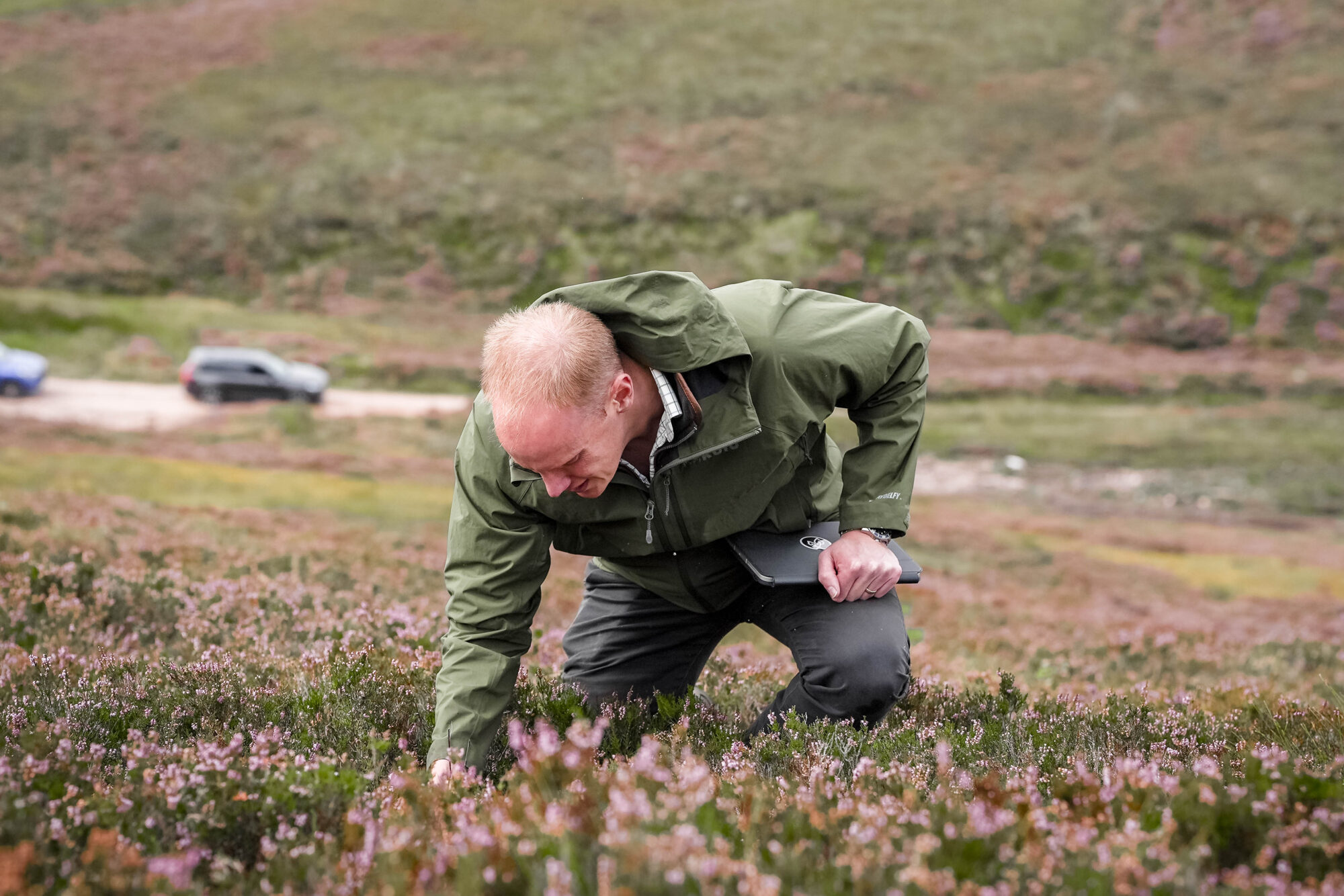
Some landscapes feel alive in an obvious way. Others ask you to slow down before they reveal themselves.
Peatlands are like that.
I remember, as a boy, stepping out of the wind into a peat hag to have my lunch when walking on the moor with my father. Even then, before I properly understood what I was looking at, there was something about those places that held my attention. The ground soft underfoot in that way only peat can be. The deep, earthy smell — rich and almost sweet — that you don’t find anywhere else. The kind of smell that tells you this ground has been building itself for a very long time.
I remember one autumn day in particular, the wind low and steady across the moor. I’d dropped down into a peat hag where the face had been exposed, and for a while I just sat there looking at it. Below me, a small burn carried a slow trickle of dark, tea-coloured water, winding its way through the landscape.
And once you’ve seen it like that, you don’t really look at peat the same way again.
What Peat Is — And How It Was Made
Peat forms at a rate of around a millimetre a year.
That means a metre of peat can represent a thousand years of accumulation.
We have drained and degraded most of ours in a few decades.
That mismatch, between the time it takes to form and the speed at which we have used it, is what peatland restoration is really about. And why this work sits at the heart of what we do at Oxygen Conservation.
Peat is, at its simplest, partially decomposed plant material that has built up over thousands of years in waterlogged conditions.
But peat doesn’t just happen. It is built — actively, persistently — by living things. And the chief architect is sphagnum moss.
Sphagnum doesn’t simply grow on peatlands. It creates them. These mosses acidify the water around them, locking up nutrients and suppressing the bacteria that would otherwise break dead plant matter down. They hold up to twenty times their dry weight in water, keeping the ground permanently saturated. In doing so, they engineer the very conditions — waterlogged, acidic, oxygen-starved — that allow peat to form beneath them. The green, living surface is the engine. The dark layers below are the archive.
When you look at a healthy peatland, what you are really seeing is a community of mosses that has been quietly curating its own environment for thousands of years — building the ground beneath your feet one millimetre at a time, and holding the water, the carbon, and the chemistry in place as it goes.
Layer after layer of compressed plant matter. Colours shifting from pale browns through to deep, almost black tones. Old roots. Fragments of moss. Bits of wood that had no right still being there.
You could run your hand along it and feel the story not in years, but in centuries.
A Resource We Have Used — And Overused
For generations, peat has been used as a resource.
Cut and dried to heat homes. Extracted for compost and horticulture on a large scale. Drained to make land more productive for agriculture and forestry. Managed in ways that prioritised short-term use over long-term function.
None of this happened without reason. People used what was available to them.
But the issue isn’t that peat has been used. It’s the speed at which we have used it compared to the time it takes to form.
We have taken something that builds over centuries and removed or degraded it in decades.
And that imbalance has consequences.
When Peat Dries, It Changes Everything
Peat only functions properly when it is wet.
Drain it through grips, ditches, overgrazing, or compaction and oxygen enters the system. Once that happens, the stored organic material begins to break down.
Carbon that has been locked away for thousands of years is released back into the atmosphere. The ground subsides. The structure collapses. The ability to hold water is lost. Instead of acting like a sponge slowing water, supporting biodiversity, regulating flow the system begins to fail.
Dry peat also becomes something else entirely: fuel. When peatlands dry out, the risk of wildfire increases significantly. And peat fires are not like surface fires. They burn deep, they smoulder, and they release vast amounts of carbon while destroying the very structure we are trying to protect.
So, when peat dries, we don’t just lose habitat. We lose function. We lose carbon. We lose resilience.
The Work We Are Doing at Oxygen Conservation
Across our estates, peatland restoration is a fundamental part of landscape recovery.
We begin by understanding the system properly.
Where is the peat? What condition is it in? How deep is it? We carry out peat depth surveys to understand the extent and volume of the resource we are working with. Where is water moving and where is it being lost? What interventions have taken place historically? What is realistic to restore?
From there, we design estate-specific approaches.
Blocking drainage. Re-wetting systems. Herbivore management where needed. Monitoring change over time. Allowing the land to recover function, rather than forcing it into an artificial endpoint.
We are already seeing what this looks like in practice on our Scottish estates. Areas of peat that were once dry, cracked, and losing function are now beginning to hold water again. After the first winter storms, watching those systems re-wet — seeing water settle back into the landscape and remain there — is a quiet but profound transformation. Ground that had been silent and failing starts to feel alive again. And where the water returns, so does the moss — sphagnum beginning to recolonise bare peat, green spreading slowly back across surfaces that had been dark and exposed for decades.
This work is not isolated. It connects directly with everything else we are doing — woodland regeneration, habitat creation, water management, biodiversity recovery.
Because when peat functions properly, it supports the entire landscape around it.
Why Restoration Matters — And Why It’s Not Simple
Restoring peatlands is not about making them look a certain way. It’s about restoring function.
At its core, peatland restoration is about water. Holding it. Slowing it. Letting it sit in the system long enough for peat-forming processes to begin again.
That often means blocking drains, re-wetting dried areas, stabilising exposed peat, and creating the conditions for vegetation particularly sphagnum to return.
But this is not a standardised process.
Every estate is different. Every peat body is different. Depth, history, drainage, vegetation, exposure, grazing pressure all of it shapes how restoration needs to be approached.
Some areas require grip blocking. Others need reprofiling. Some need grazing changes. Some need active intervention. Others need time and protection.
And even when you get it right, this is slow work.
You are not restoring something that returns in a few seasons. You are restarting a process that takes decades, even centuries.
The Landscape We Are Working Towards
I want people to walk across our peatlands in the future and feel that same quiet depth I felt sitting in that peat hag years ago.
Wet ground underfoot. Moss rebuilding. Water held in the system. Insects moving through pools. A landscape that is functioning again — not forced, not finished, but working.
Because peatland restoration isn’t about returning something to a fixed point in the past.
It’s about giving it the conditions to continue forming.
We have used peat for generations. That is part of our history. But the speed at which we have used it, compared to the time it takes to form, means we have to change.
To stop. To restore. To rebuild function.
Because if we don’t, we don’t just lose peat. We lose everything it quietly holds together.
Author: Charles Owen, Head of Estates.